Knowledge Base
Working guides for members, club officers and district committees.
What belongs here, how it is organised, and how to get an article added.
This knowledge base collects the working detail that club officers and district committees need in one place, so it is not scattered across email threads and WhatsApp groups.
How it is organised
Articles are grouped by topic in the sidebar — getting started, running a club, membership, Foundation and grants, youth, public image, and district matters. Use the filter box at the top of the sidebar to search by keyword, and Expand All to read straight through.
Getting an article added or corrected
Anything here can be corrected or expanded. Send the detail to the district Public Image team and it will be added — including a correction to this page.
Where a script or a figure needs checking before you use it, the article says so at the top.
The seven causes Rotary organises its service and grant funding around.
Rotary International directs its service work and Foundation grant funding through seven areas of focus. Most club projects map onto one of them, and a global grant application must.
- Peacebuilding and conflict prevention
- Disease prevention and treatment
- Water, sanitation and hygiene
- Maternal and child health
- Basic education and literacy
- Community economic development
- Supporting the environment — the most recent addition
Alongside these sits Rotary's longest-running commitment, the eradication of polio.
When planning a project, naming the area of focus early makes the grant paperwork considerably easier later.
The four questions Rotarians apply to the things they think, say and do.
Adopted by Rotary International in 1943, the Four-Way Test is the ethical standard Rotarians apply to their dealings. It is short enough to remember and awkward enough to be useful.
Of the things we think, say or do:
- Is it the TRUTH?
- Is it FAIR to all concerned?
- Will it build GOODWILL and better friendships?
- Will it be BENEFICIAL to all concerned?
It is customary at many clubs to recite it at meetings, and it is a reasonable test to apply to a contested committee decision.
Weekly meetings are for fellowship. Club business belongs to the Board.
The weekly meetings are primarily fellowship meetings. They should not be used to make decisions on club problems, financial matters, or the details of club projects and plans.
The Manual of Procedure is clear that the Board of Directors is the governing body of the club and decides those issues in meetings held separately from the weekly fellowship meetings.
When the Board needs the members
If the Board needs to consult the membership more broadly, it may call a club Assembly. That is the correct forum for a club-wide discussion — not the weekly meeting.
Keeping the two apart protects both: business gets proper attention, and fellowship meetings stay enjoyable for members and guests alike.
Three rules worth remembering before you hit send.
Basic rules of email communication:
- Assume everything you write is a public document. Anything you send can be forwarded, printed or produced later.
- Avoid discussing other people in an email message.
- Use proper grammar and sentence structure — and spell-check your message.
Club correspondence carries the club's name. It is worth the extra minute.
Short, simple, and acceptable to any religious denomination.
Rotary invocations should be short and simple, and acceptable to any religious denomination.
Even where members are predominantly Catholic, Protestant or of another single tradition, the Rotary invocation should remain inter-denominational. Rotary's membership spans every faith and none, and the invocation should be something every member and guest present can sit comfortably through.
Assign hosts, brief the introducer, and check the thanks is covered.
Organise members to host special guests for the meeting. Hosting a guest properly involves:
- introducing them to the President and to other members;
- organising a pre-meeting drink, if that is the custom at your club;
- escorting them to their seats;
- sitting with them, and explaining the meeting procedure if they are not Rotarians;
- involving them in table discussion;
- farewelling them at the conclusion.
Before the meeting starts, check
- that the person introducing the guest speaker is present, has received the speaker's resume, and has enough information to give a dignified introduction;
- that the person giving the Thanks to Speaker is in attendance and has the certificate or gift, as appropriate in your club.
Both are small courtesies that are conspicuous when they go wrong.
The recognition order, and the wording to use.
Visiting Rotarians and guests should be explicitly recognised.
When recognising a visitor, mention in this order:
- the name of their club;
- their classification or profession;
- their designation in the club or district;
- and finally their name.
Put in a sentence:
“Fellow Rotarians, ladies and gentlemen, please help me welcome (title, their name and the name of their club).”
Then lead the applause.
How to introduce, present and seat RI officers at any Rotary function.
The following order of protocol is used to introduce, present and seat all current, past and future officers of Rotary International and its Foundation, committee members, and their spouses — at all RI meetings, functions and receiving lines:
- International President (or the President's representative)
- President-elect
- Vice-President
- Treasurer
- Other Directors
- Past Presidents (in order of seniority)
- Trustee Chairman
Where an office is not represented at your function, simply continue down the list.
What to wear, where it goes, and on which occasions.
Rotary badges may be worn at meetings, though most Rotarians today do not wear them at club meetings.
The Paul Harris badge should be displayed below the Rotary emblem.
When to wear the Paul Harris medal
- Club presentation of Paul Harris Fellows
- Opening of District Conference
- Paul Harris reunions
- The District Governor's official visit
- Other such ceremonies
Orientation, placement in a line of flags, and the basic courtesies.
Editor's note: District 9350 spans South Africa, Namibia and Angola. This article covers the South African flag only; clubs in Namibia and Angola should follow their own national flag protocol.
The South African national flag must always be treated with dignity and respect. It should be flown high and free, and must never be allowed to touch the ground or floor.
Orientation
When hung against a wall or flat surface, whether horizontally or vertically, the black triangle with the green ‘V’ should always be on the flag's own right — which means it appears on the observer's left when looking directly at it.
- Displayed horizontally: the red stripe is at the top.
- Displayed vertically: the red stripe is on the observer's left.
In a line of national flags
- Three or more flags, with one South African flag available: fly it in the centre.
- An even number of flags: fly it on the left of the observer facing the flags.
- A semi-circle of flags: fly it in the centre.
For the full rules, see the official South African government flag protocol resources published by the Department of Sport, Arts and Culture.
Suggested wording for the toast, with figures to check.
Editor's note: This script contains placeholders that must be filled before use — the membership, club, district and country figures, marked below. Check the current numbers at rotary.org rather than reusing an old script. The polio sentence also reflects the position when this text was written; verify the current status before delivering it.
Suggested content:
Distinguished guests, my fellow Rotarians, friends of Rotary.
I congratulate you all on being a part of the worldwide fellowship of Rotary International.
Service clubs seem to have become less popular during the more affluent years. But Rotary is just as necessary today as it was when it was first introduced in 1905.
Wars, civil unrest, natural disasters, water shortages and worldwide health issues continue to be a challenge for service clubs, and in particular Rotary.
You are part of over [current figure] million Rotarians, in [current figure] clubs, in [current figure] districts, in [current figure] countries. When I say you are members of the worldwide fellowship of Rotary International, I mean it literally.
Rotarians from across the world have combined to eradicate polio, a superhuman effort since Rotary took up the challenge in 1985, when polio was once again out of control in most parts of the world. [check the current polio position]
Rotary and Rotarians love a challenge.
To quote our founder Paul Harris, at the 1940 RI Convention in Havana, Cuba:
“Rotary stands; though the tempest rage about — Rotary still stands. Why and how? Because it is grounded not on fear, rivalry, and suspicion, but on the eternal and indestructible rocks of friendliness, tolerance, and usefulness.”
I am proud to be a part of Rotary International and to be a South African, and I ask you all to stand and join me in drinking a toast to Rotary International and South Africa.
“To Rotary International and South Africa.”
A response to the toast should be made by a past District Governor.
Suggested wording for inducting a first-time member.
Editor's note: A ceremonial script. Blanks marked … are filled in on the day with the club name, the proposer's name and the current club and country figures.
You have been chosen for membership of the Rotary Club of … because of your standing in your vocation and in the community, and because of your personal qualities, which we believe will make you a good Rotarian.
By joining the Rotary Club of … today, you become part of a worldwide organisation of business and professional leaders who are united in fellowship to provide humanitarian service, to encourage high ethical standards in all vocations, and to create goodwill and achieve peace throughout the world.
We accept you as a member because we believe you will adopt these high principles of Rotary as your own, and that you will do everything in your power to fulfil your membership obligations as these become better known to you.
There are, of course, many privileges of membership, and I think you will quickly find that one of the most important of these will be your regular enjoyment of the fellowship of like-minded individuals in a non-competitive and egalitarian atmosphere — not only in this club, but anywhere in the world where Rotarians gather.
Your proposer, Rotarian …, will now present you with your Rotary emblem, which should be worn at all times. This will identify you as a Rotarian and will assure you of a warm welcome in Rotary clubs in countries and regions around the world; also your name plaque, which shows your classification as well as your name. This is important, as it signifies the vocation you represent within the club, and to which you are an ambassador from Rotary.
Rotarian …, we expect much from you in the way of fellowship and Rotary service, and we in turn pledge to do all in our power to make you welcome in the club and to assist you to grow in Rotary knowledge. I particularly charge you to contact me personally if you experience any problems in your assimilation into the club, or if you believe you possess talents of value to Rotary that we appear to be overlooking.
It is with pleasure that I now extend to you the right hand of Rotary fellowship, and give you a hearty welcome as a member of the Rotary Club of …
Rotarians, would you all now rise. I present to you our new member, Rotarian …, to be known in the club as …
Would you please make yourself known to them at the first possible opportunity, to confirm in person the official welcome I have just given, and which I now ask you to support by acclamation.
Suggested wording where the new member has served in Rotary before.
Editor's note: A ceremonial script. Blanks marked … are filled in on the day with the member's name, their former club, and their committee and chair.
Thank you, …, for accepting the invitation of the members of this club to re-join us in the worldwide fellowship and service work of Rotary. This invitation was extended to you because we believe that your leadership qualities are allied to those qualities which fit you to interpret and impart the message of Rotary to your fellow man.
The principles and practices of Rotary, and the privileges and obligations of a Rotarian, are already well known to you through your active membership of the Rotary Club of …
We would hope that you will give this club the benefit of your previous Rotary experience, to further strengthen the fellowship of this club, and to help us serve even more effectively this community and the wider fields of Rotary service.
I am proud to present to you this Rotary badge. I also hand you your dinner plaque and some literature relating to Rotary and the activities of our club.
You have been appointed to the … committee, under the chairmanship of …, and we look forward with confidence to your participation in and contribution to our club's programmes, projects and activities. Much is expected from you in help and inspiration, to enable us to serve society better. I congratulate you, and offer you the right hand of Rotary fellowship.
Rotarians, join me in extending a warm welcome to our new member, Rotarian …
Why the presentation should be public, and suggested wording.
The presentation of a Paul Harris Fellow recognition is always an occasion for public attention. It recognises that a gift of US$1,000 will fund projects and programmes to improve and invigorate the lives of people around the world, and enhance international friendship and understanding.
The presentation should be made publicly, so that Rotarians realise what their Foundation is doing and how it is supported. A club meeting, a District Conference, or the visit of the District Governor are all appropriate occasions.
The recognition is The Rotary Foundation's way of expressing appreciation for a substantial contribution to its humanitarian and educational programmes. It is named after Rotary's founder, a Chicago lawyer who started our organisation with three business associates.
Suggested wording
A world of peace and good will comes closer to reality today as … becomes a Paul Harris Fellow. Their gift to The Rotary Foundation of Rotary International can carry out an array of programmes that achieve beneficial changes in our world: improved living conditions, increased food production, better education, wider availability of treatment and rehabilitation for the sick and disabled, new channels for the flow of international understanding, and bright hopes for peace.
In becoming a Paul Harris Fellow, … joins a remarkable company of persons throughout the world, all recognised for their devotion to the ideal of goodwill, peace and understanding. It is the goal of Rotarians the world over, and one that … clearly shares.
It gives me real pleasure, …, to present you with the three emblems of appreciation given to Paul Harris Fellows — certificate, medallion and pin. We congratulate you, and we thank you for your commitment to the programmes of The Rotary Foundation of Rotary International.
AI is not what makes organisations sound alike. Lazy prompts are. The four questions to answer before you open the tool.

AI is not making organisations sound the same. People are.
AI learns patterns. If everyone gives it the same lazy instruction — “write a Facebook post about…” — everyone gets the same answer back. The sameness is not a property of the tool. It is what happens when nobody does the thinking first.
The difference it makes
Here is the opening everyone has already seen:
Today we celebrated another incredible milestone as our amazing volunteers came together to make a meaningful difference in the lives of our community…
And here is one that could only have been written by somebody who was there:
At 6:30 this morning, Nomsa carried 40 litres of water home before her children left for school.
The second is shorter, plainer and specific. Nothing in it could have been generated by a model that was not told what actually happened.
Ask the better question
Do not ask what AI can create for you. Ask what only you can create with AI.
Great prompts cannot rescue poor thinking. Before you open your AI tool, answer these four:
- What happened?
- Why does it matter?
- Who changed?
- Why should anyone care?
AI comes afterwards. If you cannot answer the four questions, no prompt will cover for it — the tool will simply fill the gap with the average of everything it has already read.
Next: Five rules for using AI in Rotary communications, and writing for the channel.
By Sarah van Heerden
AI is a tool. Accountability for what it produces stays with the writer, the communicator and the club.
This is the important distinction: AI is a tool, and we are accountable.
If AI invents something, the software is not accountable. The organisation is. The writer is. The communicator is. That responsibility never transfers.
The five rules
- Never publish anything you cannot verify. If you cannot check it, it does not go out.
- AI cannot witness. It was not at the handover, the meeting or the build. Only somebody who was there can supply what actually happened.
- Respect people’s dignity. The people in our stories are not illustrations of our generosity.
- Use AI to improve writing. Never outsource thinking.
- Your voice is your brand. A club that sounds like everyone else has given away the one thing that was already its own.
AI can predict words. Only humans can recognise truth.
See also: the thinking comes first, and writing for the channel.
By Sarah van Heerden
One story, three lengths — and what separates a weak prompt from one that actually works.
Magazine storytelling and social media storytelling are not the same job, and the most common mistake is writing one and posting it as the other.
Magazine versus social media
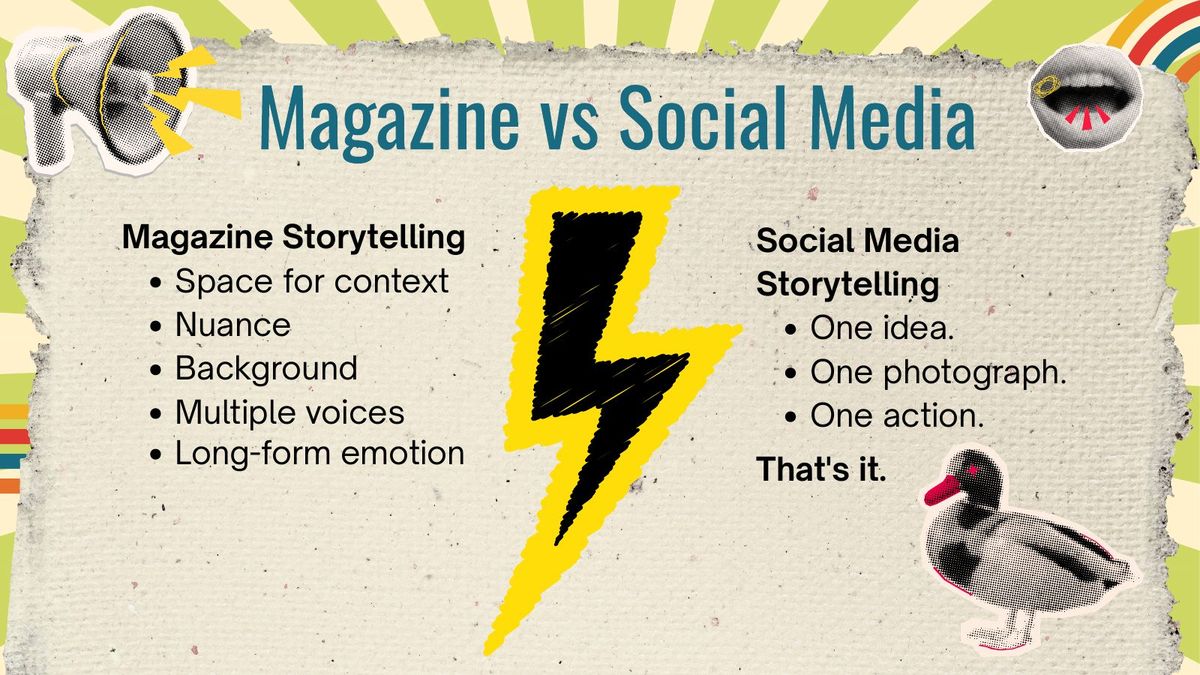
Magazine storytelling has room for context, nuance, background, multiple voices and long-form emotion.
Social media storytelling has room for one idea, one photograph, one action. That is it.
Stop writing everything everywhere
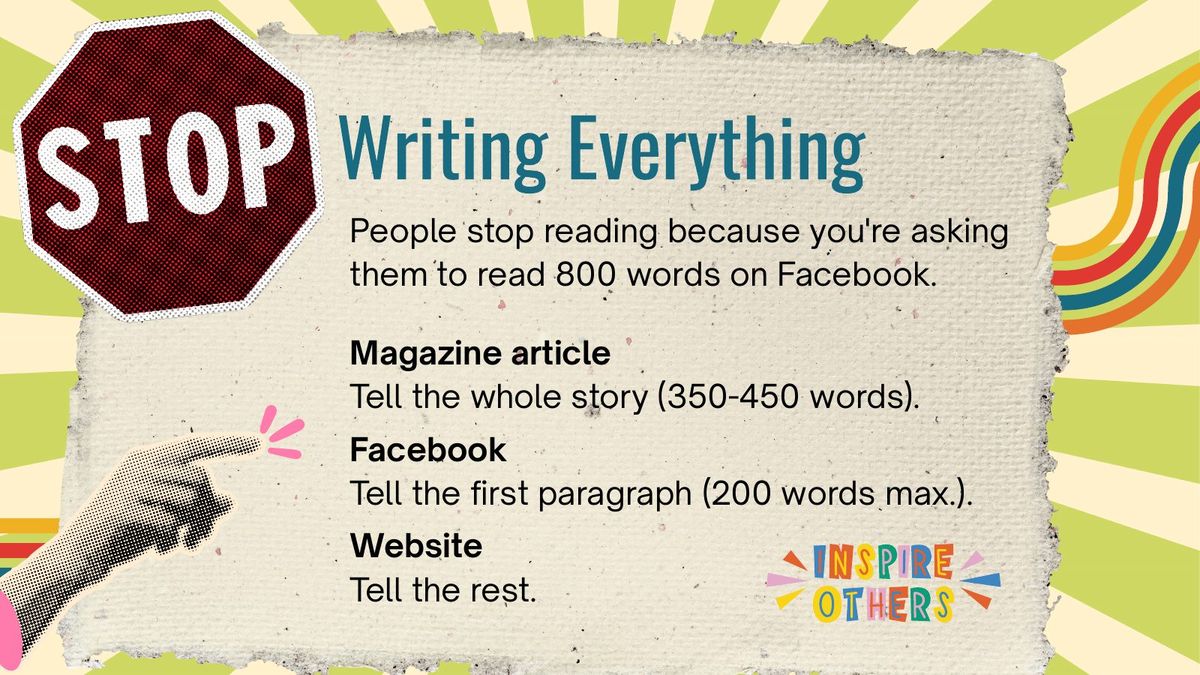
People stop reading because you are asking them to read 800 words on Facebook. Split the same story by channel:
- Magazine article — tell the whole story (350–450 words).
- Facebook — tell the first paragraph (200 words maximum).
- Website — tell the rest.
What a good prompt looks like
Instead of:
Write a Facebook post.
Try:
Write a Facebook post in under 120 words. Make the first sentence impossible to ignore. Avoid clichés. Do not use “making a difference”, “journey”, “excited”, “thrilled”, “heartwarming”, “meaningful impact” or “community spirit”. End with a question.
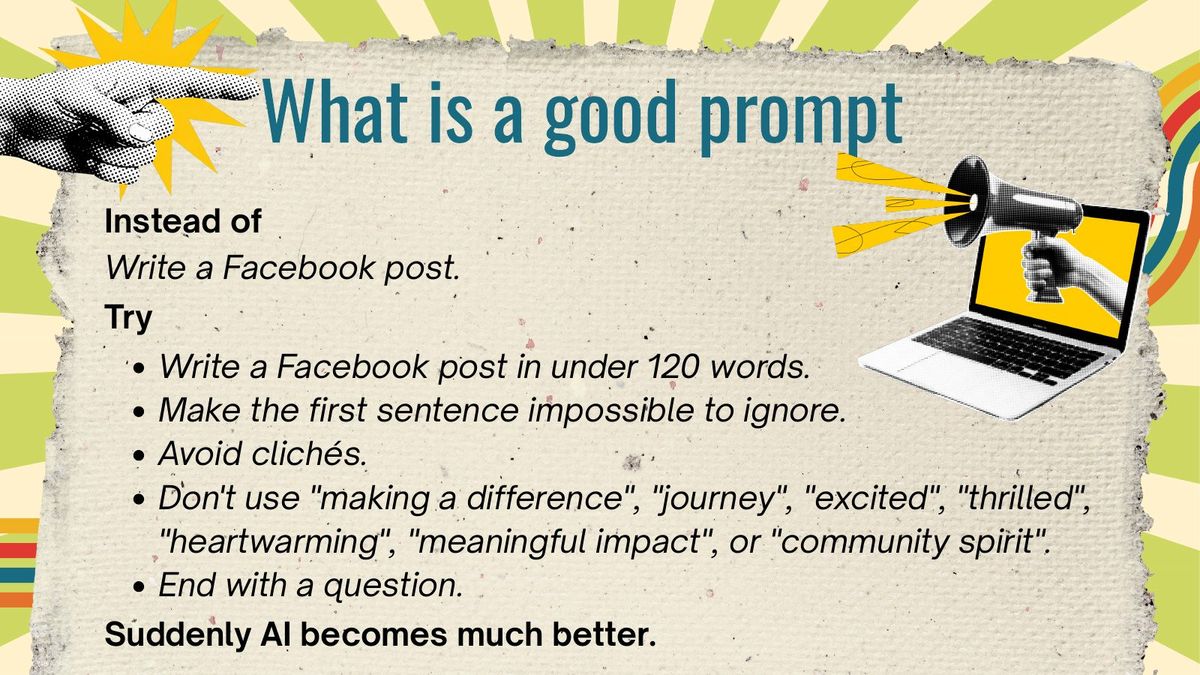
Suddenly AI becomes much better — because the constraints, the banned phrases and the ending were all decided by a person.
The point of all of it
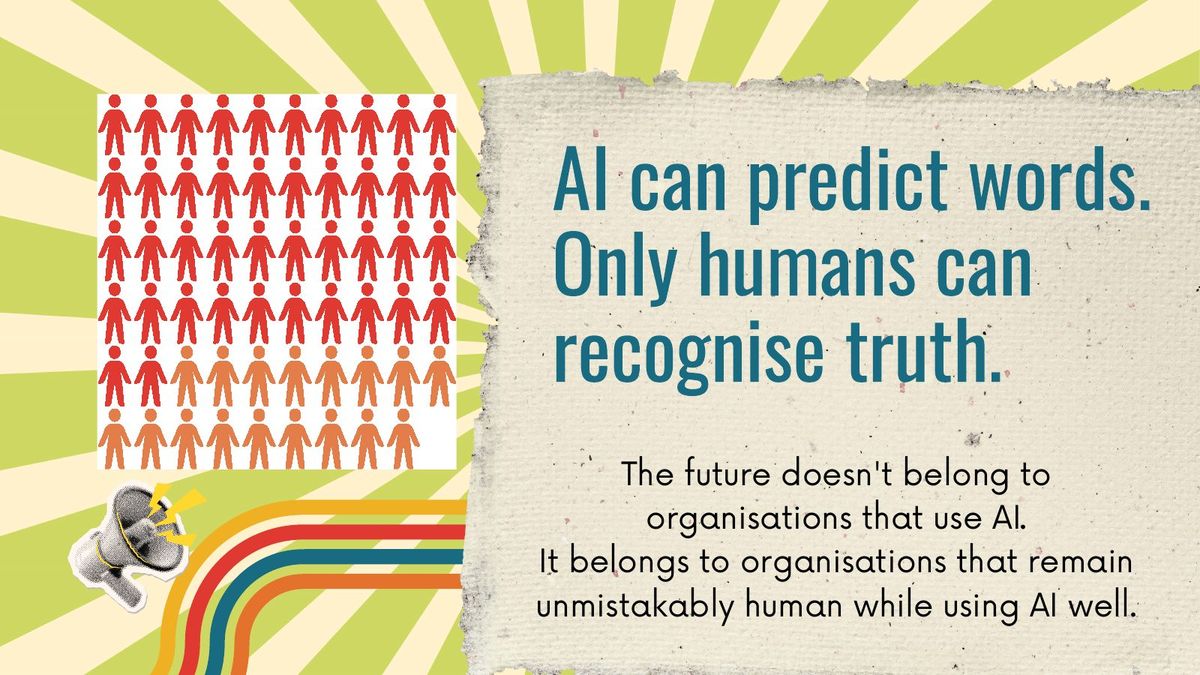
The future does not belong to organisations that use AI. It belongs to organisations that remain unmistakably human while using AI well.
See also: the thinking comes first, and the five rules.
By Sarah van Heerden
One of the few duties Rotary International actually requires of a club.
Hosting the District Governor for the official club visit is one of the few duties actually required of a club by Rotary International.
What to expect
- The District Governor may wish to meet the club Board approximately 30 minutes to one hour before the meeting.
- The District Governor is the programme for your meeting on the day of the visit — do not schedule another speaker.
- It is an occasion to which partners and guests should be invited.
Treat it as a set-piece meeting: confirm the Board session, the programme and the invitations well in advance.